kautū
1. (verb) to wade.
Kei tahuna he ahi, kei pūhia rānei he manu hei kai, kua kitea rātau e ngā hōia Pākehā. Nō tētehi pō, ka puta rātau i ngā putanga hōia. I te piri o te ara ki ngā tūtei, ka rongohia atu rātau e taki kōrero ana. Ka kautū haere mā te repo, kātahi ka whakawhiti i te moana o Waikare mā te waka (TTR 1990:212). / They could not light fires or shoot birds for food in case they were discovered by the Pākehā troops. One night they slipped through the soldiers' lines, moving so close to the sentries that they could hear them talking. They waded through a swamp, then crossed Lake Waikare by canoe.
Synonyms: kau
2. (verb) (-ria) to swim, wade.
Ka whakautu atu au, 'E Rihi, kāore au e mōhio ki te kau.' (HP 1991:20). / I replied, 'Rihi, I don't know how to swim.'
Synonyms: kautū
ngutu parore
1. (noun) wrybill, Anarhynchus frontalis - a pale-grey wading bird with a black bill, the tip of which is curved to the right. Breeds in the shingle riverbeds of Canterbury and Otago from August to January, migrating to estuaries of the North Island for the rest of the year.
(Te Pihinga Textbook (Ed. 2): 9;)

tōrea
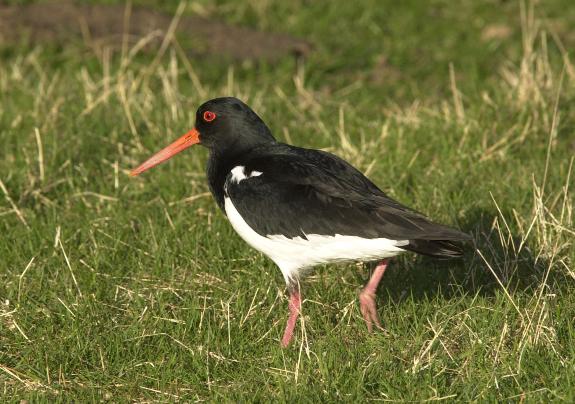
1. (noun) oystercatcher, pied oystercatcher, Haematopus ostralegus - a sea-coast wading bird with black-and-white or all-black plumage and a thin orange-red bill. Feeds chiefly on shellfish, worms, insects and small fish. Breeds on inland riverbeds and farmland of the South Island.
(Te Māhuri Textbook (Ed. 2): 116;)
Synonyms: tōrea tuawhenua
2. (noun) pied stilt, Himantopus himantopus - a black-and-white wader with very long pinkish-red legs and a long, fine, black bill. Usually found in flocks.
(Te Pihinga Study Guide (Ed. 1): 1;)
See also poaka
Synonyms: turuturu pourewa, turituri pourewa, tuturi pourewa, tuturu pourewa, poaka


ngutu pare
1. (noun) wrybill, Anarhynchus frontalis - a pale-grey wading bird with a black bill, the tip of which is curved to the right. Breeds in the shingle riverbeds of Canterbury and Otago from August to January, migrating to estuaries of the North Island for the rest of the year.
(Te Pihinga Textbook (Ed. 2): 9;)
See also ngutu parore

kareni
1. (loan) (noun) crane - wading birds with long legs, long neck and straight bill.
I korokī ahau, pērā i tā te warou, i tā te kareni; i tangi ahau me te kūkupa; matawaia ana ōku kanohi i te tirohanga whakarunga (PT Ihaia 38:14). / Like a crane or a swallow, so I chattered; I mourned like a dove; My eyes fail from looking upward.
tōrea tuawhenua
1. (noun) South Island pied oystercatcher, pied oystercatcher, Haematopus finschi - a sea-coast wading bird with black-and-white or all-black plumage and a thin orange-red bill. Feeds chiefly on shellfish, worms, insects and small fish. Breeds on inland riverbeds and farmland of the South Island.
Synonyms: tōrea


kakao
1. (noun) old bar-tailed godwit, Limosa lapponica - a brown-and-white migratory wading bird with a long, slightly upturned, black bill and a pink base which breeds in the northern hemisphere and summers in the southern.
2. (modifier) red, scarlet, red feather.
He kahu kura te kākahu (NM 1928:87). / The garment was a red feather cloak.
Synonyms: pākurakura, ura, whero, nganangana, ngangana, tōwhero, waipū, kākaramea, pūwhero, hīwera
3. (noun) red feathers, feathers used as decoration, treasure, valued possession, heirloom, precious possession, sacred, divine law, philosophy, darling, chief.
Takoto mai, e koro, kia tangihia koe e ō iwi. Auē! Ka mau te punga here o te waka nei. Ka ngaro koe, te kaihautū, te kākākura o roto i te pōkai, te puhi o Aotearoa, te kura whakahirahira o Te Waipounamu, te mauri o te whenua, te mauri o te tangata, haere! Haere rā! (TP 7/1906:9). / Lie in state, sir, to be wept over by your people. Oh, dear! The anchor of this canoe is taken. You are gone, the fugleman, the leader of the flock, the adored one of the North Island, the important treasure of the South Island, the life force of the land and the people. Depart! Farewell!
Synonyms: tapu, whakatapu, puaroa, rapunga whakaaro
4. (noun) glow.
Ko ngā ingoa o taua kura koia tēnei - he āniwaniwa, he koroirangi kei te rā, kei te marama, kei te whakaumu te marama, te rā rānei, koia nei ngā whakahua. Engari ko te tino ingoa ia he kurahaupō tō te marama, he kura-hau-awatea tō te rā (JPS 1927:357). / The names of that glow are these - āniwaniwa and koroirangi pertain to the sun or moon, when the moon or sun are encircled, those are the terms. But the genuine names are kurahaupō, that is of the moon, and kura-hau-awatea is that of the sun.
5. (noun) bar-tailed godwit, Limosa lapponica - a brown-and-white migratory wading bird with a long, slightly upturned, black bill and a pink base which breeds in the northern hemisphere and summers in the southern. This term is applied to the red plumage of the bird immediately prior to the migration to the northern hemisphere.
Ka mārama pea te manu nei: he kuaka te ingoa iwi, he kura, he kakao, he karoro, ngā ingoa hapū (HKW 1/11/1901:1). / This bird probably needs explaining: the species name is 'kuaka' and 'kura', 'kakao' and 'karoro' are the varietal names.
See also kuaka
Synonyms: rakakao, kakao, hakakao, tarakakao, rīrīwaka, kuhikuhiwaka, karoro, kuaka
karoro
1. (noun) seagull, southern black-backed gull, Larus dominicanus - a common large gull with a heavy bill. Body plumage entirely white except for wings and back which are black above. Bill is yellow, eyelid orange-red and iris white. Legs and feet are olive. Young bird in its first winter has a black bill, dark brown feet and is mottled below and barred above grey and brown (see illustration).
Ānō he karoro e topa ana i runga i ngā kaimoana (TP 12/1903:4). / Like a black-backed gull soaring above seafood.
Synonyms: toie, kaiē, rāpunga, pohio, kōtingotingo

2. (noun) bar-tailed godwit, Limosa lapponica - a brown-and-white migratory wading bird with a long, slightly upturned, black bill and a pink base which breeds in the northern hemisphere and summers in the southern. This term is applied to the godwit when it is feeding during the southern hemisphere summer and the breast is accumulating large amounts of fat and the plumage is the basic pale plumage.
Tuatahi mō te karoro: Ko tōna uma katoa he mā ngā huruhuru, ko ngā parirau me te tuarā i rite ki ō ērā atu (HKW 1/11/1901:1). / Firstly about the karoro: The feathers of its breast are totally white, and the wings and back are like those other varieties.
See also kuaka
Synonyms: tarakakao, rīrīwaka, kuhikuhiwaka, kura, kuaka, kakao, rakakao, hakakao
3. (noun) ribbed venus shell, Protothaca crassicosta - an oval-shaped bivalve mollusc found on open sandy beaches just below low tide.
kuhikuhiwaka
1. (noun) bar-tailed godwit, Limosa lapponica - a brown-and-white migratory wading bird with a long, slightly upturned, black bill and a pink base which breeds in the northern hemisphere and summers in the southern. An important source of food, Māori distinguished three varieties based on their plumage and age: 1. an older bird (kakao, hakakao, rakakao); 2. a red bird (kura) preparing to migrate; and 3. a whiter bird (karoro).

rīrīwaka
1. (noun) pūrua grass, Bolboschoenus fluviatilis - a sedge with long leaves and a stem reaching up to 2 m high. Found in fresh or brackish water mostly north of Rotorua.
See also kukuraho
2. (noun) bar-tailed godwit, Limosa lapponica - a brown-and-white migratory wading bird with a long, slightly upturned, black bill and a pink base which breeds in the northern hemisphere and summers in the southern.

kuaka
1. (noun) bar-tailed godwit, Limosa lapponica - a brown-and-white migratory wading bird with a long, slightly upturned, black bill and a pink base which breeds in the northern hemisphere and summers in the southern. An important source of food, Māori distinguished three varieties based on their plumage and age: 1. an older bird (kakao, hakakao, rakakao); 2. a red bird (kura) preparing to migrate; and 3. a whiter bird (karoro).
(Te Pihinga Textbook (Ed. 2): 2; Te Māhuri Textbook (Ed. 2): 34;)
Ko te manu reka pea te kuaka o tēnei mea o te manu; ki te hunga kai kuaka, ki te takoto mai he kuaka, he kūkupa (kererū) kāore e mahara ki te kūkupa; mā te pau o ngā kuaka kātahi ka kai i ngā kūkupa (TP 1/11/1901:2). / Perhaps the tastiest bird is the godwit; to the people who eat godwit, if godwits and pigeons are laid out they don't think about the pigeon; only when the godwits are consumed will they eat pigeons.
See also kakao, hakakao, rakakao, karoro, kura
Synonyms: tarakakao, rīrīwaka, kuhikuhiwaka, kura, karoro, kakao, rakakao, hakakao